Search Posts
Recent Posts
- How to Donate a Vehicle in Louisiana: The Act of Donation Explained
- Lost or Stolen Louisiana License Plate: How to Get a Replacement
- Real Estate Signings in Louisiana: What the Notary Does and What to Bring
- Bought a Car Out of State? How to Transfer the Title in Louisiana
- How to Renew Your Louisiana Vehicle Registration and License Plate
Categories
- Auto Title (4)
- Farm Vehicles (2)
- License Plates (3)
- Notary Services (4)
- Off Road Vehicle Decals (1)
- Off-Road Vehicles (2)
- Out of State Title Transfer (2)
- Titling Guides & How-To's (4)
- Vehicle Registration (1)
Tags
Contact Us
In Louisiana, the OMV looks for proof that your vehicle is used solely for agricultural operations, is owned or leased by a farming entity, and is never used for personal or non-agricultural business driving. Officers and OMV staff check for proper documentation, qualifying activities, compliance with vehicle weight limits, and whether usage matches the declared farm purpose.
TL;DR
- OMV checks whether the vehicle is used strictly for agricultural operations.
- The vehicle must be owned or leased by a farming business or producer.
- Personal use or non-farm commercial use will disqualify eligibility.
- Weight class, load type, and route patterns matter.
- Misuse can lead to citations, fines, tax assessments, or plate revocation.
Here’s a short video overview:
Anyone who’s ever stood in line at a Louisiana OMV knows how nerve-wracking it can be to get answers about farm-use plates. Farmers tell us all the time that the rules feel vague and different depending on who they talk to. That’s why we put together this guide, straight talk about what OMV employees and law enforcement actually look for when approving, inspecting, or flagging a farm-use plate.
And if you want a deeper breakdown of the basic qualifications, you can also check our complete Louisiana farm-use vehicle guide .
What Does the Louisiana OMV Consider a “Farm-Use” Vehicle?
Before OMV staff issue or renew a farm-use plate, they consider the vehicle’s purpose , ownership , and use patterns .
To qualify under Louisiana regulations, the vehicle must be:
- Used exclusively for agricultural operations
- Owned or leased by a farmer, rancher, grower, or agricultural business
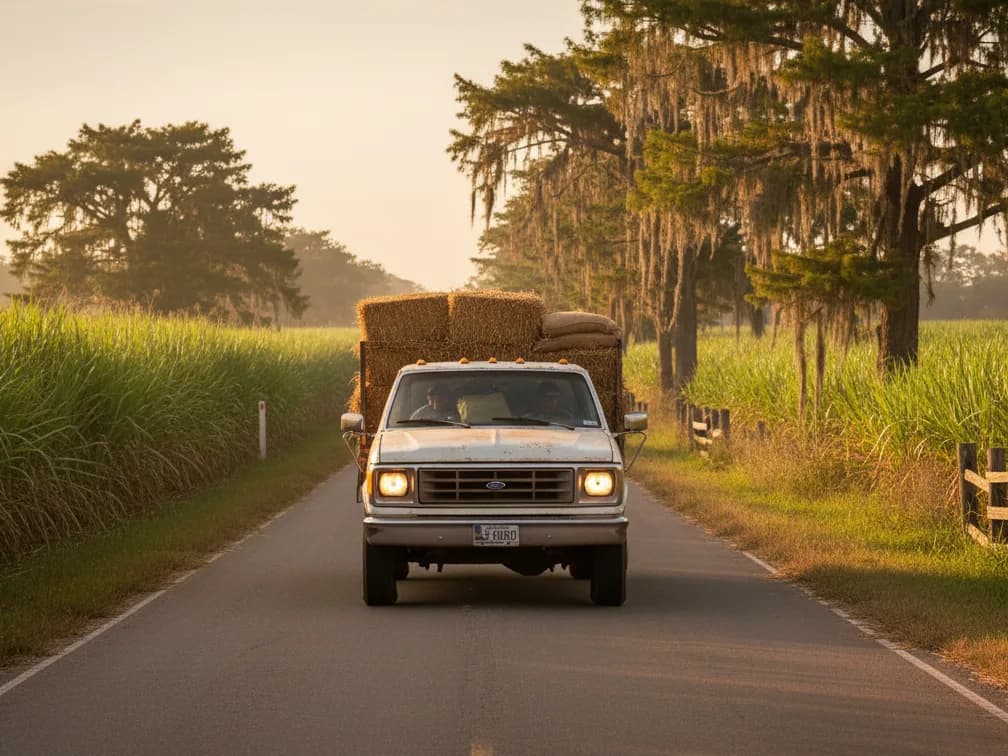
- Hauling crops, livestock, equipment, feed, or supplies
- Operating mainly on or between farm properties
If OMV suspects that your vehicle is being used for personal errands or non-agricultural business, your application will be denied, or your plate may be revoked later.
What Documentation Does the OMV Need for Farm-Use Plates?
Most folks think the OMV requires a mountain of paperwork, but the truth is, they only need a few key documents to prove your vehicle is tied to real farm work.
Need a notary step for your packet? Read our Covington walk-in notary guide before you come in.
1. Proof of Ownership or Lease
OMV wants to confirm that the vehicle is used for a farm operation. Acceptable documents include:
- Vehicle title
- Lease agreement
- Bill of sale
- Business ownership documents
2. Proof of Agricultural Activity
Louisiana does not require massive acreage to qualify. Even small agricultural operations can meet the standard. However, OMV may ask for evidence such as:
- Farm business registration
- USDA farm number
- Agricultural sales receipts
- Tax documents showing agricultural income
3. Usage Confirmation
You may be asked to confirm how the vehicle is used:
- Transporting feed or seed
- Moving livestock
- Hauling equipment
- Transporting harvested crops
- Driving between farming locations
Louisiana OMV’s Top Approval Factors (What They Check First)
Approval Factor
What OMV Evaluates
Vehicle Use
Is the vehicle used solely for agriculture?
Ownership
Is it owned/leased by a farmer or ag business?
Load Type
Are the loads agricultural in nature?
Route Patterns
Does driving stay between farm locations?
What Agricultural Activities Qualify Under Louisiana Law?
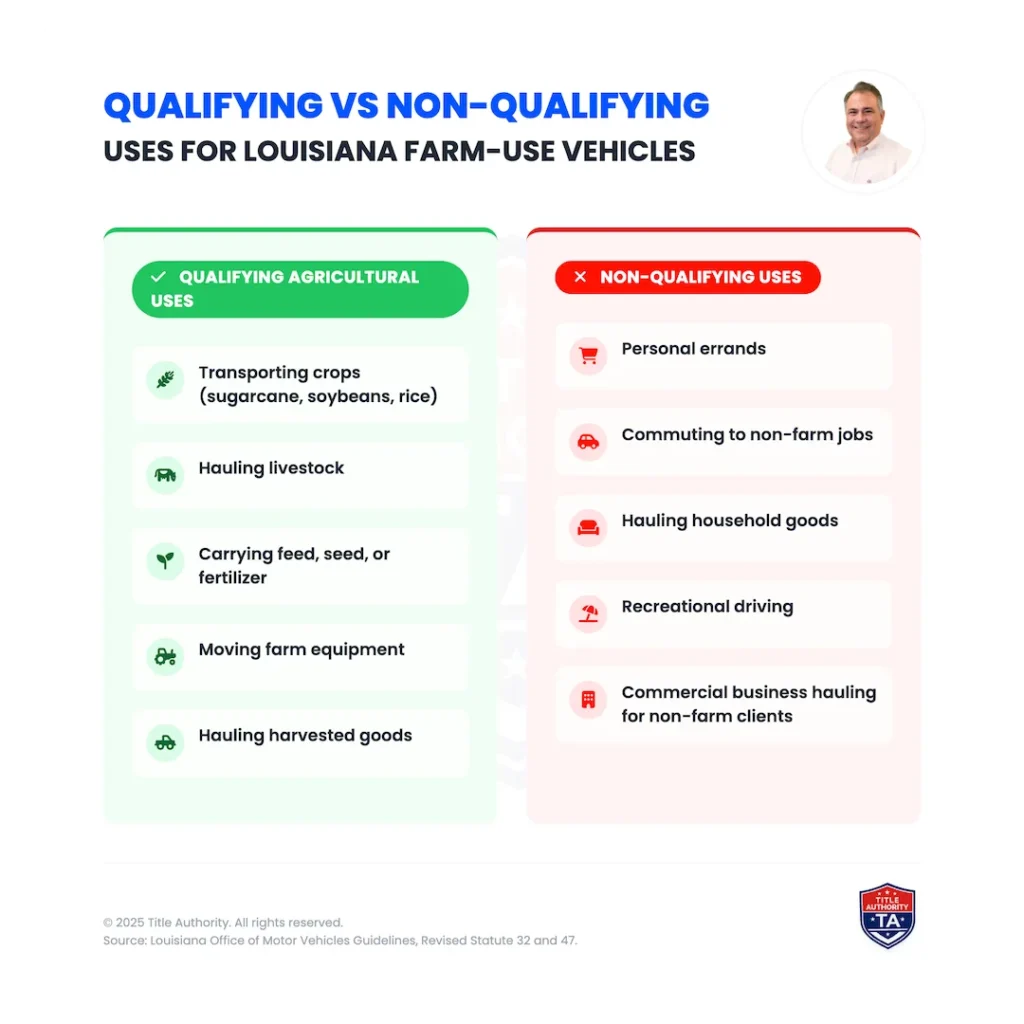
To meet OMV requirements, your vehicle must support one or more farm-related activities. These include transporting crops, moving livestock, hauling feed and seed, carrying fertilizer or chemicals, and moving equipment between fields or farm properties.
Louisiana’s agricultural footprint is large, and the OMV uses that reality to determine what activity should reasonably count as farm use. The state’s production levels show just how common it is for farmers to rely on trucks and trailers to move goods between fields, barns, storage sites, and mills.
According to the USDA National Agricultural Statistics Service 2024 Louisiana Crop Summary , the state harvested sugarcane on 519,400 acres and produced more than 16.3 million net tons of cane. Soybeans remain one of Louisiana’s largest crops as well, with roughly 1.06 million acres harvested in 2024. These crops alone require constant movement of seed, harvests, and equipment between fields and processing sites.
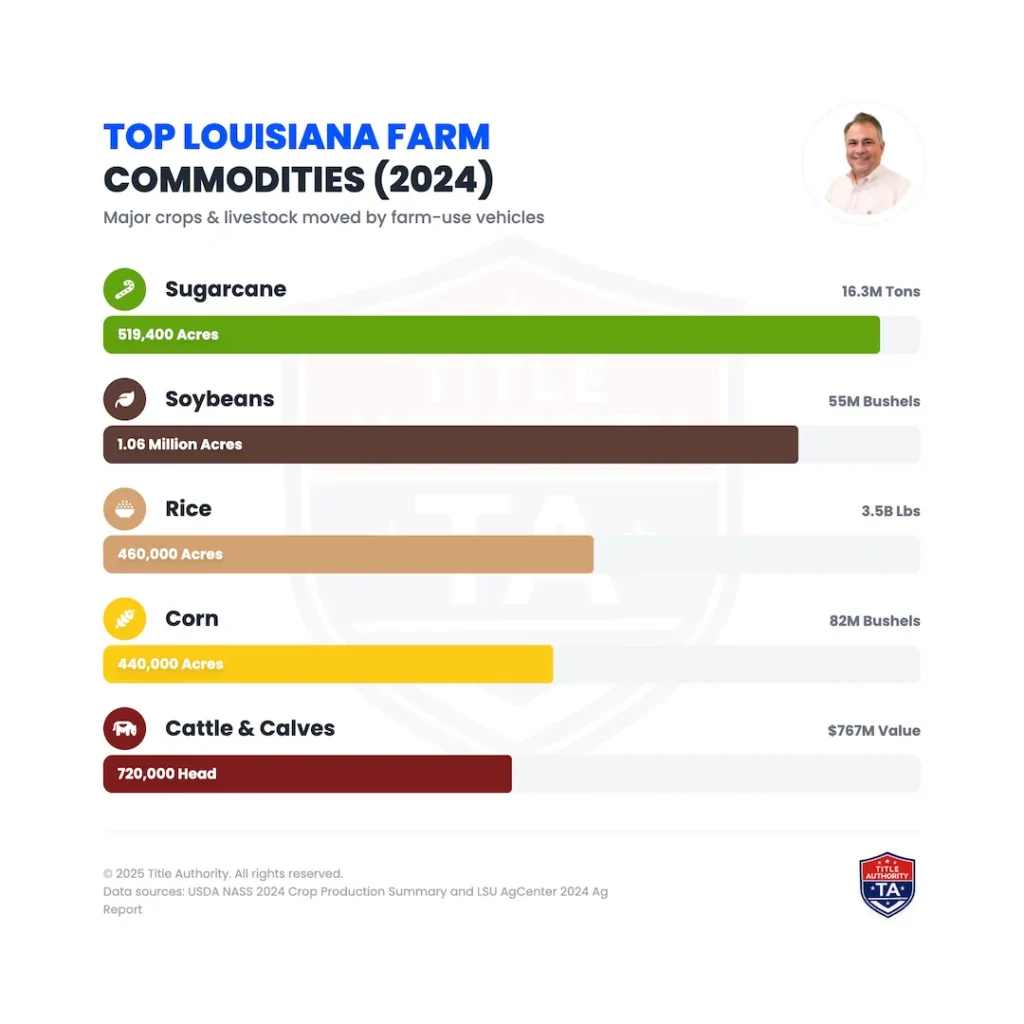
The LSU AgCenter’s 2024 Agriculture Overview also lists sugarcane, soybeans, rice, and cattle as some of the state’s highest-value agricultural commodities. Cattle and calf production spans nearly every parish in Louisiana, making livestock transport another clear example of legitimate farm use.
In short, if your truck or trailer is regularly hauling crops, livestock, feed, seed, fertilizer, or equipment that directly supports these types of farm operations, the OMV generally considers those activities to be eligible agricultural use.
Examples of approved agricultural uses include:
- Transporting harvested sugarcane, soybeans, corn, or rice
- Moving cattle, poultry, or other livestock
- Hauling seed, feed, fertilizer, or agricultural chemicals
- Moving tractors, sprayers, or implements between fields
- Delivering fencing, lumber, or supplies for farm repairs
- Farm-to-farm trips between properties owned or leased by the same operation
These activities align with Louisiana’s agricultural sector and demonstrate legitimate farm use, which is why OMV approval focuses heavily on whether your vehicle supports this type of day-to-day work.
What Activities Will Get Your Farm-Use Plate Rejected or Revoked?
This is where most farmers get into trouble, misuse .
OMV considers these activities disqualifying:
- Driving to the grocery store
- Commuting to a non-farm job
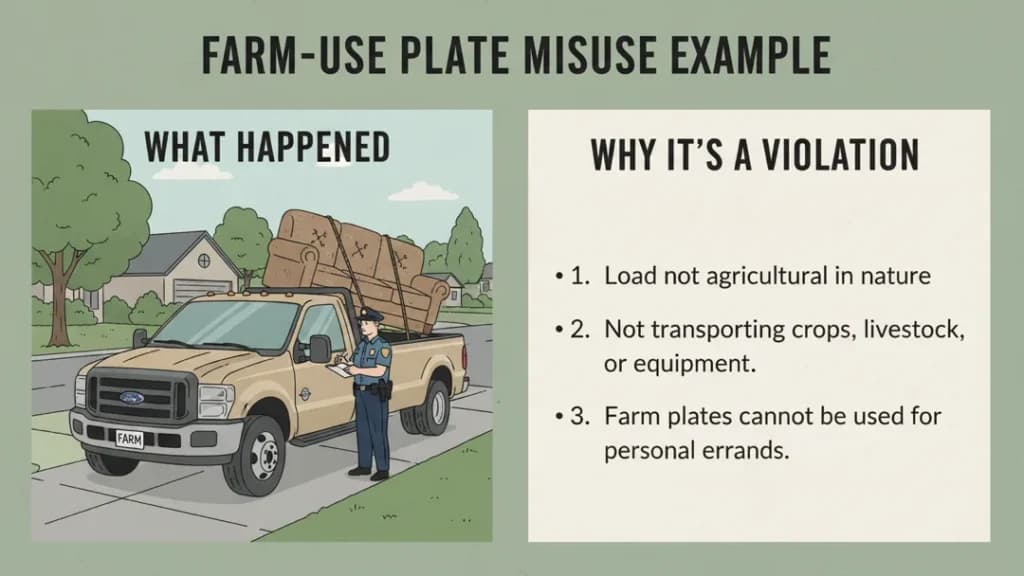
- Hauling furniture or personal items
- Using the vehicle for a non-agricultural side business
- Taking family trips or recreational drives
- Moving non-farm commercial loads
Real example: A customer once used his farm-tagged F-350 to help his brother move a couch. The officer stopped him, the load didn’t match the farm activity, and a citation was issued .
Do Officers Pull Over Farm-Use Vehicles in Louisiana?
Yes. And they often do it more frequently during harvest seasons.
Officers check:
- Load type
- Driving route
- Plate compliance
- Safety conditions
- Whether usage matches farm-related statements on file
Your Shortcut If You Want to Avoid OMV Mistakes
If you’d prefer to skip the OMV line entirely, we process Louisiana farm-use plate applications in-house at our Covington office.
- Paperwork
- Eligibility checks
- Plate processing
- Compliance verification
Fast, local, and no wasted time at OMV.
Learn more about our farm-use license plate service
Louisiana Farm-Use Plate Requirements Checklist
Requirement
Condition
Vehicle used strictly for farming
Yes
Owned/leased by a farming operation
Hauls crops, livestock, or supplies
Allows personal errands
No
ATVs/UTVs qualify
Eligible for roadside inspection
Louisiana Farm-Use Plate Requirements FAQ
If you want clarity straight from the practical side of OMV rules, these FAQs cover the questions farmers ask us most before applying for a farm-use plate.
Does the OMV require proof that my farm is active?
Yes. OMV generally looks for evidence of real agricultural activity, especially for new applicants.
Can I occasionally use my truck for personal errands?
No. Even “once in a while” personal use can result in citations or plate removal.
Do livestock or crop hauls need to be documented?
Not always, but if an officer asks, being able to explain the purpose of the trip matters.
What if I use my vehicle 90% for farming and 10% for personal use?
OMV considers any personal use disqualifying.
Ready to get your farm-use plate without the OMV hassle?
Post Tags :
Share :
Latest Blogs
How to Donate a Vehicle in Louisiana: The Act of Donation Explained
Lost or Stolen Louisiana License Plate: How to Get a Replacement
Talk to the counter
- Hours
- Mon-Fri9:00AM - 5:00PM
- Sat10:00AM - 2:00PM
- SunClosed